
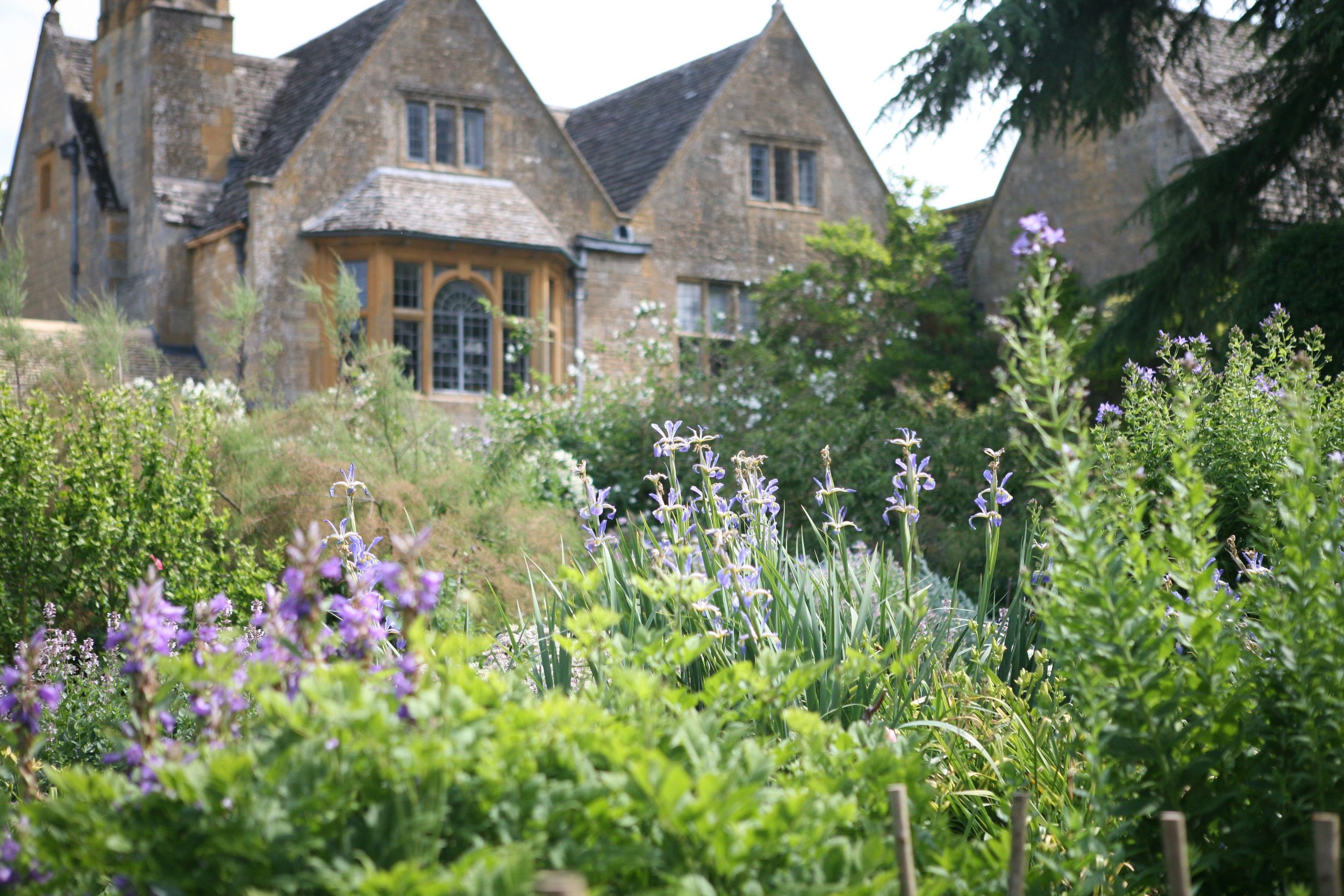
This view of an arts and crafts garden show the house being embraced by the plantings. Though carefully planned and maintained, the result looks romantic and carefree. Hidcote, Gloucestershire, UK. 1920's.
The industrial revolution - marking the separation between consumer and producer - gave birth to the arts and crafts movement that championed a return to design and craftmanship. The arts and crafts garden represents an extension of this philosophy. In execution, this garden style combines contrasting formal hard-scape with effusive informal plantings. Hedges and walls create intimate themed garden rooms close to the house. Orchards and meadows exist further from the house. More a philosophy than strict style, the arts and crafts allows the gardener a lot of freedom of expression. Advocates included garden writer Gertrude Jekyll, and gardeners Vita Sackville-West, Harold Nicolson, and Lawrence Johnston, who created the tour-de-force gardens at Sissinghurst and Hidcote.
Check out the posts below for other examples of gardens inspired by the arts and crafts style.

Counting down to tulip season! Legend Beatrix Farrand wrote in 1941, “In the spring, probably the best bulbs to use will be Tulips, in such colors as may be found attractive. The cheapest groups which can be bought in large quantities are those of the mixed Darwins, preferably running toward the yellows, bronzes, and oranges..." Her Plant Book for Dumbarton Oaks is full of garden advice...

Pulling into Riverbend in Kohler, Wisconsin is like entering another world. This arts and crafts style English manor house with its picturesque setting takes us back 100 years. It provides a case study in how to create a garden that looks older than it actually is...

At some point we all have the urge to tear out our gardens and start over again. After enough changes occur, the desire might be to restore a garden to its original design. Though many houses and gardens were created to be one integrated unit, that intention can get lost over time. Here is the story of one such restoration...

Sharing our landscapes with friends is one of the pleasures of gardening. Nature opens the mind and relaxes us; it takes us out of our inner world. As I look to other gardens for inspiration, Frank Lloyd Wright reminds me of the power of building destinations in the garden, and spaces to facilitate conversation...

With the US elections over, some Americans have joked about moving abroad. In the early 1900’s, quite a few Americans did just that and Italy was a favorite destination. Among these expats were Hortense Mitchell and Arthur Acton who settled outside of Florence to restore an old villa and its gardens. Where would you go? What kind of garden would you create?

Like many gardeners I love to borrow ideas from beautiful landscapes. But this is not always easy. Sometimes the challenge is to scale down something grand; some ideas are prohibitively expensive; sometimes ideas are just not practical. This is why I so appreciate Frank Lloyd Wright's ability to combine inexpensive materials in innovative ways...

“No experience necessary. All welcome.” The posted sign captures the inclusive and inviting spirit of this ornamental garden at 91st Street on the middle level of Riverside Park in New York City. To me, this garden represents hope. It is an improbable garden built on top of railroad tracks in the middle of one of the most dense cities in the world.

“The good building is not one that hurts the landscape, but one which makes the landscape more beautiful than it was before the building was built.” - Frank Lloyd-Wright Among the things that Wisconsin is famous for it is Frank Lloyd Wright’s Taliesin in Spring Green, Wisconsin, that has most intensely captured my attention...

For many things in life, bigger isn’t always better. Beatrix Farrand’s garden at Bellefield, in Hyde Park, New York, is a good example. Despite its relatively small size, Farrand employed many of her signature techniques. The garden at Bellefield is full of practical ideas that can be adapted to our gardens today...
“Fight for a just cause; Love your fellow man; Live a good life” was the favorite credo of the creators of this quintessentially American gilded age country house and garden. The first 2 letters of each phrase, FI-LO-LI, form the name of this special place. It also is an apt description for the garden today….